Thursday, 17 May, 2012

No time to talk. Carnival -- Caribana -- is here for the 45th time

 
.

But a Toronto Summer is always Hot, Hot, Hot.
Jump Up. Jump Up. In the land of  snow
 (feature article for WinTV's inflight magazine - Trinidad) 
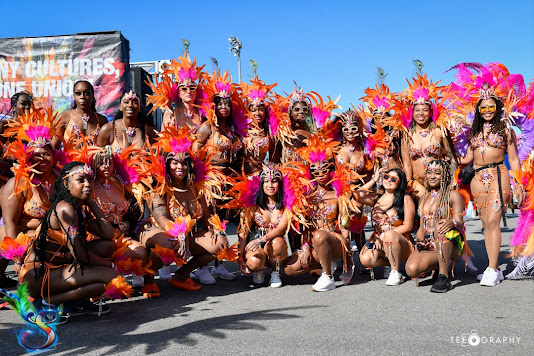
Playing Mas in downtown Toronto - photograph by Andrew Weir
In Canada, carnival is done differently. In Trinidad, you might even call it backwards. But hey, if you can get a million people to jump up, you gotta be doing something right.
At Carnival in Trinidad, everyone plays Mas in the street.  The players out-number the people watching by a long shot.  In Toronto?  There are million people cheering on the 16,000 people playing Mas along the city’s waterfront!
The Scotiabank Toronto Caribbean Carnival is getting ready to hit the streets of Toronto, this August 4th.  This is the 45th year for the festival formally known as Caribana, and not only is going to be bigger, it is going to be better.
The Toronto festival runs for three weeks and attracts over a million people from Ontario, the United States and the Caribbean. 
It all starts July 17th at Toronto’s city hall.  The public square is jammed to see the official launch to the festival. In years gone by, people like Roy Cape and David Rudder, have helped get the huge crowd in the mood for Carnival.
On July 21st the first BIG event takes place at Downsview Park when the junior carnival parade takes place. Think of it as a kiddie’s version of the big parade.  Last year over 2,000 children performed for the judges and played Mas in the streets of Toronto. Downsview Park, a new location for this event, is so large it was used to host a visit by the Pope!
Watching it all happen. Specatators line the Toronto Carnival parade route - photograph by Andrew Weir
Not interested in seeing the kids?  You may want to take in the  Canada versus  the best of the Jamaica Rugby League in a festival cup match that will be held in downtown Toronto on the 21st.
Dress for most Festival events is casual – to say the least.  However, there is one event where formal wear is the rule of the evening.  The Annual Gala is a dress up affair to honour the rich history of the festival and to watch samples of the Caribbean arts. This year it all happens on July 27th along the city’s waterfront.
Some of the world’s best Calypso performers live in Toronto.  They will be showing their stuff in the annual Monarch Contest on July 28th and then again on the 31st at an All-Star  Showcase at the Government run Harbourfront lakeside park.
Summer classic. Playing Mas in  the streets of downtown Toronto - photograph by Andrew Weir

Silver Stars - World's best steel drum orchestra perform. AW
And the hits keep coming.  There is a huge outdoor Pan Alive battle of the steel pan orchestras.  The King and Queen contest on August 2nd is always a sell-out, and the Parade along Toronto’s waterfront, is the largest outdoor event in Canada!  And this year people  are invited to stay up all night, after the parade has ended and take part in the festival’s new Fish Fry at Ontario Place, and Sunday food festival.
Mas photo by Andrew Weir
By the time the parade day arrives, the city is hopping with Festival events. Almost every entertainment establishment in the city and surrounding area has “Caribana” parties planned.
These events are big – how big? – the larger events, starring people like Destra and Machel Montana, have audiences of 5,000 and larger.  That is a lot of people having fun together and that can’t be backwards can it?


.

Tuesday, 15 May, 2012

Lismer got it right. There is La Cloche, and then there is the rest of the world

Jon Butler opens his exhibition of photographs, on display in the RBC Tower on Bay Street. Part of Contact Festival.
Jon Butler uses his camera to have a Group of Seven moment in God's Country
La Cloche Spirit: The Equivalent Light, opens in Toronto. Part of Contact Festival


 Jon Butler at one time was an integral part of the Thomson News Corporation. Publisher. Newspaper Executive.  Nowadays, he lets others write the news, while he pursues beauty with his camera in Northern Ontario.
 On Monday evening Butler opened an exhibition of photographs he took in the La Cloche region of Georgian Bay.  The show launch was held in the lobby of the  Royal Bank's Bay Street Tower as part of the month long Contact Photography Festival.  Three Ontario and Federal cabinet ministers, a over 50-art lovers attended the opening sponsored by Vale's Base Metals, a Toronto based mining company.
The La Cloche area, known for the beauty of its quartzite mountains, crystal clear lakes,  and abundant wildlife, is located in Northern Ontario on the north shore of Georgian Bay near  the Killarney Park (east) and the town of Spanish (west). Butler lives in Willisville, located in the heart of La Cloche.
Art writer/expert Tom Smart (right) with Jon Butler
This area was recently saved from the possibility of any future mining.  In 2011, the sponsor of the evening's launch, Vale,  surrendered the license for the district so it may be enjoyed for generations to come. Butler was instrumental in saving the Mountain and establishing the La Cloche Mountains Preservation Society.
"La Cloche Spirit is a photographic exhibition that explores the light of dawn and how it evokes an inspirational space and translates the timeless beauty of nature," said Butler at the Contact event. "After the practice of Stieglitz, an “equivalent” photograph functions as a work of art because it both communicates subject matter and suggests mental states."
The retired newspaper man is now a Zen practitioner and has, as he writes, "changed his clothes to enjoy the passing seasons of life." He says that he has been capturing and enjoying the light of La Cloche for more than 30 years. He concentrates on solitary, contemplative landscapes and atmospheric effects with his natural light photographs. They reflect years of meditation on the subject matter and draw viewers into the light of La Cloche.
Butler isn't the first artist to be inspired by La Cloche. Group of Seven painter, Arthur Lismer visited Georgian Bay for the first time in September of 1913.  It is recorded that he was dumbstruck by the impact of the landscape.
His paintings of La Cloche established a unique style of of seeing the pools, rocks, crags and trees that  have made his work so distinct. While a guest of Dr. James MacCallum ( an early patron of the Group) at his Georgian Bay, Lismer began a life-long love affair with Georgian Bay and La Cloche, and would return there to work throughout his life. 
Butler’s exhibit ‘La Cloche Spirit: The Equivalent Light’ will be up at 200 Bay St., South Tower Lobby, Royal Bank Plaza to Saturday, May 26 and at The Gore Bay Museum Heritage Centre from June 10 to August 6.


Monday, 14 May, 2012

Street Art: Max Dean hands out memories at Contact Photography Festival

Yes, we accept exchanges. Artist Max Dean, takes back a photography album from a woman who found the pictures depressing.  She get another album from Max.  Dean gives away albums to strangers throughout the Contact Festival from the back of his Volkswagen " Foto Bug".  The Foto Bug was parked in front of MOCCA when this photograph was taken.
Have Album Will Travel - artist gives away photographic memories in the street
Over the past decade, performance artist Max Dean has collected over 600 photo albums. Family Memories. Forgotten Records. Pictures of the past.
At the official opening of the Contact Photography Festival in Toronto, Dean told a large audience at the Museum of Contemporary Canadian ArtGallery, that it was time that he got rid of his collection of albums. Rather than simply throw them away, Dean has made the act of divesting himself of his collection as a performance-based work of art.
" About 100 of the albums have been donated to the Art Gallery of Ontario," Dean told this website, while standing beside an aging Volkswagen Bug.  " Over the next 4-weeks I will be taking my "Foto Bug" (the modified Volks) to key intersections in downtown Toronto and giving away albums to strangers! It is an incredible responsibility (on the part of the person taking one of his family photo albums)."
According to the Centre for  Contemporary Canadian Art's on-line Database,  "Max Dean is a Toronto-based artist who has been producing works of significance for over 35 years. His performances, sculptures and installations explore the complex relationship between the artist, the spectator and the work. His interactive kinetic installations that explore the nature of trust and control."

Max Dean opens the Contact Photography Festival in Toronto by announcing he will give away hundreds of photo albums
CONTACT is an annual festival of photography in Toronto, during the month of May, with over 1000 local, national and international artists exhibiting at almost 200 venues. Founded as a not-for-profit organization 16 years ago, and now a charitable organization, the festival is devoted to celebrating, and fostering the art and profession of photography. It stimulates excitement and discussion among a diverse audience that has grown to over 1.8 million. CONTACT is the largest photography event in the world, and a premiere cultural event in Canada.
From the best of Facebook (popular postings by sweir)


Friday, 11 May, 2012

86-year old Arnaud Maggs Wins It All - Scotibank Photography Award

 .
  $50,000 Cash Prize. A Book Deal and An Exhibition Next Year

2012 Scotiabank Photography Award
L-R, MC and Arts Editor at the Globe Gabe Gonda, Janes Nokes, Exec. Dir. SPA
with SPA winner Arnaud Maggs; and photographer Ed Burtynsky, Chair SPA.
Toronto artist Arnaud Maggs received the second annual Scotiabank Photography Award (SPA) at a ceremony held this evening at Toronto's Design Exchange.  Celebrating excellence in contemporary photography, the $50,000 award, solo Scotiabank CONTACT Photography Festival exhibition in 2013 and book deal with international art photography publisher Steidl, is Canada's largest prize for an established Canadian photographic artist.
"To receive this award is an honour, and it too is an honour to be named in the company of my gifted peers, Fred Herzog and Alain Paiement," said Arnaud Maggs. "Scotiabank's work over the past years both through its involvement in the Scotiabank CONTACT Photography Festival and now the Scotiabank Photography Award  is helping to raise the profile of Canadian photography and the people and stories behind the lens."
Best known for his multiple-grid, serial photographs of faces and collections, systems and historical ephemera, Arnaud began his career as an artist in the mid seventies at the age of 47, following success as a graphic designer and commercial and fashion photographer. Works, collections and exhibits include Complete Prestige 12" Jazz Catalogue, Charles Stainback's Special Collections and the Arnaud Maggs: Identification exhibition which opened at the National Gallery of Canada in Ottawa on May 3, 2012. Maggs is represented in Toronto by the Susan Hobbs Gallery.
"Arnaud Maggs has made a unique contribution to Canadian art and photography with his clear and original way of looking at the world around him," said Ann Thomas, Curator of Photographs Collection, National Gallery of Canada on behalf of the SPA jury. "Under his unswerving and affectionate eye, he brings to a new level of appreciation both the idea of human identity represented through the photographic portrait and the idea of cultural evidence garnered through the traces that everyday things leave behind. We are grateful to him for opening our eyes to the significance of ordinary things."
L-R, Stephen Weir, Arnaud Maggs,photographer Ed Burtynsky
photographs by Tom Sandler
The SPA was conceived and developed by Ed Burtynsky, one of Canada's most respected photographers and Jane Nokes, Director of the Fine Art Collection and Corporate Archives at Scotiabank. Burtynsky serves as Chair of the SPA and Nokes is the Award's Executive Director. Both serve on the Board of the Scotiabank CONTACT Photography Festival, the largest photography festival in the world. The SPA 2012 was sponsored by Canadian Art, CTV and the Globe and Mail.
"Arnaud is the master of the archival image," said Nokes. "His excellence as a photographic artist is a given, his extraordinary use of the ordinary is a wonder. Arnaud is all about archives, and as a professional archivist, I am in awe of his use of history to inform his work. His ability to bring the past into the present in a meaningful way makes him the archivist's hero as well as the art curator's dream."
The 2012 SPA jury:
  • William Ewing, Director of Curatorial Projects, Thames & Hudson
  • Karen Love, Manager of Grants and Publications and Independent Curator, Vancouver Art Gallery
  • Ann Thomas, Curator of Photographs Collection, National Gallery of Canada 

Sunday, 6 May, 2012

The Shy Eye. Photographers don't make the best models!


Shy Guy Alain Paiement
 Pointing a YouTube camera in the faces of Canada’s BEST photographers
(Huffington Post Blog by Stephen Weir)


If you can get a photographer to talk, oh the stories you will hear...
Over the years I have handled publicity assignments for some of Canada’s best known artists, authors, and, now and then, photographers.  Although one shouldn’t make sweeping generalities about the personality traits of red hot artists, when it come to photographers, the best cliché is “Mum’s the Word”.
Authors know that the gift of the gab sells books, and for centuries, painters have been expected to attend their exhibitions. Sculptors appear larget than life – just like their carvings.
But, photographers are different. Really different. Doesn’t matter what language. Open the dictionary to the word "shy" and it will likely read: photographer.
They see the world with a box held to one eye, separating them from their subject.  For Montreal's Lynne Cohen (who won the first Scotiabank Photography Award  [2011], the barrier between the public and picture taking is even wider. Her large format camera, complete with a light-blocking sheet that she ducks under to focus her camera, keep her persona well hidden.
I have been assisting with this year’s Scotiabank Photography Award (SPA).  There are three photographers in the running:  Montreal’s Alain Paiement, Toronto’s Arnaud Maggs and Vancouver’s Fred Herzog -- all exceptionally talented, and worthy of national treasure status. The winner is going to be announced on Wednesday.
As part of the assignment, I helped create five videos ( four in English; one in French) with this year’s shortlisted photographers. Also helped create a video at a SPA sponsored exhibition for last year's winner Lynne Cohen. 
Normally, it would difficult to get these seasoned photographers in front someone elses camera. But, SPA is Canada’s richest photography prize - $50,000 cash, a curated art exhibition and a publishing and distribution deal with Steidl (Germany) -- so the artists have been quite generous in supporting the publicity cycle.
They made the time to stand in front of our cameras and talk candidly about the art that they produce.  A good picture is a good picture, but, when its creator describes what is actually going on in the photograph, it becomes a masterpiece.  As a result, the SPA videos are about Canadian masterpieces.
Photographic artist, Arnaud Maggs lives and works in Toronto.  
 http://youtu.be/Ucx18omI7gE
 Videographer George Socka and myself filmed and talked to Maggs at the Susan Hobbs gallery where his After Nadar exhibition was hanging.
Maggs was, “inspired by a series of  photographs of the celebrated French pantomime Pierrot, taken by the Parisian photographer, Nadar in 1855." In his new show, writes Susan Hobbs, "Maggs' newest images are a restaging of these photographs using himself as the sitter.”
Three things excited Maggs during our conversation. Why? He was happy with the Susan Hobbs exhibition, and thrilled with the Scotiabank Photography Award nomination.  He was also looking forward to the opening of his new show at The National Gallery of Canada in Ottawa.
In April I took the train to Montreal to film Alain Paiement. I didn’t have the luxury of a long stay, and I filmed Paiement for both an English and French language YouTube video, returning to Toronto the same day.
Muse Magazine informed me that for twenty years, Alain Paiement has been a major figure in contemporary photography. His genius lies in his 'spatialization' of photography and unique construction of vision.  His lens takes the ceilings off homes and businesses to giving the viewer a bird's eye view of what really goes on inside.
http://www.youtube.com/watch?v=_M-NKm8_U2E 
http://www.youtube.com/watch?v=2iUlV4cZb4U 
While we sat in his Rosemont Studio he explained that he was reclusive by nature, “I am very much an outsider, I don’t know that many people. This nomination is my (coming out party).”
Videographer Dr. Phil Nuytten of Vancouver, builds submarines, designs space age dive suits and he owns Diver Magazine (to which I frequently contribute).
When Phil has time, he likes to talk to artists.  Lucky me.  He volunteered to take his cameras to the Equinox Project Space to interview Fred Herzog, the third finalist for the Scotiabank Photography Award,
Nuytten’s six-minute video should have had a musical soundtrack using Paul Simon's hit, Kodachrome. (Copy right. Sigh). You see, the 82-year Herzog has used slide film to capture pictures of downtown Vancouver during the first 50 years of his career.  His body of work IS the history of the city, documented in vibrant Kodachrome colour.
As with many Canadians artists, it took took a half century for Herzog to become an overnight success. Nuytten was able to get him to talk about his new book, his work and the SPA nomination.
http://www.youtube.com/watch?v=8iA874sbAwY 
The final video was taken at the Design Exchange earlier this week by Socka.  During the press preview of the SPA exhibition Lynne Cohen: Nothing is Hidden (which is part of her SPA prize); he wanted to capture Ms. Cohen’s reaction to this comprehensive exhibition and her new 172 page book. Both are a major draw at this May's CONTACT photography festival in Toronto. 
Out from behind the camera - Lynne Cohen at show preview

Typical of a photographers' need for obscurity she revealed that for years she had naively named all of her works "untitled".  She realized that that wasn't working, she told him, when photographs were getting mixed up by galleries and in reprint, so she has since given each of image a subtitle after the ubiquitous "untitled". 
http://www.youtube.com/watch?v=3xNuUvGfiNo

Just who wins the second annual Scotiabank Photography Award  remains to be seen until later this week. I am guessing that typical of most photographers, these artists would rather be behind the viewfinder or out in the field, than be at the centre of camera flashes Wednesday night.

Sunday, 29 April, 2012

Update on the death of diver Judy Swann April 13, 2012

ONTARIO 2012: Fatalities - Summaries & Recommendations

I am assisting the Ontario Underwater Council with the writing of fatality reports following the death of any scuba diver in provincial waters.  I have posted an earlier version of the report - what follows is current as of April 29, 2012. 
The report was put together by:
Stephen Weir          Sport Safety Consultant
Ayisha Hassanali   Sport Safety Consultant
Raimund Krob        Sport Safety Advisor

One can see a more complete version of this report at the Ontario Underwater Council's website 

Fatalities - Summaries and Recommendations are listed in chronological order.

Summary:

Dive Site:
On Friday, April 13th, a 58-year old Caledon woman (Judy Ann Swann) and her husband (Eric Tolton) were planning on doing a dive to check out her brand-new dry-suit. The locations they considered for doing so included Welland Scuba Park and Humber Bay Park West. They chose Humber Bay Park West because it was closer. As this would be their first time diving at this site, they obtained a briefing on the site beforehand.

Satellite image of incident site (blue dot):


Photo of North Beach Entry Point:

Photo by Raimund Krob


Dive Site Description:
The entry point is a rock beach a few metres/yards away from a parking lot. From shore, the bottom has about a 1:6 gradient, or 1 foot / metre of depth for every 6 feet / metres out. The day of the incident was sunny with mild winds and waves out of the south-west. Water temperature at the surface was 6 degrees C.

Dive Plan:
Eric and Judy’s dive plan was to first have Judy get geared up and go out to a depth just above her head and then do a buoyancy check, while Eric stood by on shore with additional weights if she needed them.
o      If Judy was able to descend, then she was to inflate & come back to the surface, wait for Eric to get geared up, and then the two of them would go on their dive.
o      If Judy was not able to descend, then the plan was for her to swim into shore, get the additional weights from Eric, and then do the buoyancy check again. If she was then able to descend, then she was to inflate and come back to the surface, wait for Eric to get geared up, and then the two of them would go on their dive.

When they arrived on site in the parking lot, they met another diver (Elliott Cristofoli) who was already preparing to go on his dive. Eric and Judy discussed the conditions with Elliott and then decided to use the north entry instead of the south entry because conditions while good in both locations were slightly better on the north.

Elliott then went on his dive while Eric and Judy unpacked and geared up.

Shortly after Elliott returned from his dive, Eric and Judy made their way from the parking lot to the north entry, a rocky beach a short walk from the parking lot.

Elliott recollected that Judy was fully geared up, and Eric had his dry-suit half on and was carrying two yellow two-pound weights.

Eric described Judy as feeling fine and excited about checking out her new dry suit.

Shortly after that, Judy entered the water with her snorkel in her mouth, but when she got out far enough to do her buoyancy check, something (not yet known) happened to her to cause her to become completely unresponsive. Eric shouted to Judy several times to put her regulator in her mouth, but she did not respond and then slowly sank under the surface.

Eric then entered the water with his dry-suit still half on. Judy had by then sunk to the bottom and was in a head-down, feet-up orientation. Eric described trying to reach Judy to inflate her suit, but with the flooded suit and underwear and cold water (6 degrees C at surface), it was impossible for him to do so, and so he began shouting for help.

A passing cyclist heard Eric’s cries and alerted Elliott, who was disassembling his gear and loading it into his trunk. Elliott grabbed his mask and ran to the beach. He helped Eric (who Elliott described as being in a state of hypothermia / shock) out of the water, and then swam out to help Judy. Elliott saw Judy outlined below but had no means of getting down to her.

Elliott then swam back to shore, ran to his car and got his bail-out bottle & regulator. He borrowed Eric’s fins, and then holding his bail-out bottle in one hand swam out to rescue Judy. With his other hand, he grabbed one of Judy’s legs, towed her into shallower water, inflated her BCD, and then proceeded to give her rescue breaths.

Bystanders assisted in the rescue effort, EMS was activated, and shortly afterwards the Metro Marine Unit responded, followed by land ambulance.

Judy was taken to St. Joseph’s Health Centre a short distance away, where she was kept on life support until approximately 5:00 p.m. on Sunday, April 22nd.

As of the revision date of this report, the Coroner’s office has not yet completed their testing and/or analysis of those test results, and has not yet notified the family of the cause of death or the reason for Judy becoming unresponsive in the first place.

Carotid Sinus Reflex was considered as a contributing cause but was ruled out as the neck seal of the dry-suit had previously been trimmed at the store during the fitting process.

OUC Recommendations to Prevent Recurrence:

1.     Buddy teams of divers should make every effort to do as much as possible together, including gearing up together, entering the water together, and checking buoyancy together.

2.     Dry suit divers should ensure their dry-suits are zipped completely closed before entering the water.

3.     Certain types of scuba equipment such as dry suits may be easier and safer to use with           appropriate Instruction / Training / Supervision beforehand. If you have any questions as to whether Instruction / Training / Supervision might apply to your scuba equipment acquisition, ask your local scuba professional (Retailer, Instructor, etc.).

4.     When checking out dry-suits for the very first time, divers should strongly consider doing so in a confined-water pool-like setting, rather than in an open water setting (many retailers and clubs book pools for this purpose).

5.     This incident was similar in many respects to the fatality of Robert Cupick in 2006, so OUC should make its “Ontario Scuba Diving Incident and Prevention Reports” more visible. . 

For public domain information of this incident, please refer to Section C, Appendix #1 of this document.

Thursday, 26 April, 2012

Descending now airing in Canada

 
.

The Low Down On An Upcoming Scuba Show
(May issue of Diver Magazine)
By Stephen Weir 


A brand new Canadian based underwater TV series is descending to new heights thanks in part to its use of cutting edge video cameras. The Outdoor Life Network (OLN) has begun airing  Descending,  a scuba adventure TV series that uses the new Red One digital video camera to get hyper-real footage from the bottom of Lake Ontario to the wild waters of New Zealand.
The Red One, built by the Red Digital Cinema Camera Company (founded by Oakley owner Jim Jannard) is in the vanguard of the next generation of digital broadcast cameras.  Relatively small, pretty cheap ($25,000, not counting the  70 lb Gates waterproof housing) the Red has the ability to shoot highly detailed video images in very low light, far outstripping the capability of high def TV sets to show such amazing quality.  Underwater the Red One sees and records images more accurately than the human eye.
This year’s Underworld Awakening horror movie was made using the Red.  The TV series Justified is filmed with the same camera.  The makers of the new series Descending, believe they are the first dive show on television in North America to use the Red.
"Our cinematographer Andre Dupuis bought two  ... One is a back-up, and so far we haven't had a (catastrophic flooding of the housing) " said Descending on-air host Scott Wilson.  " 70% of the planet is underwater.  We are taking viewers to see what most of us have been missing, so it is important that the footage is spectacular."
According to the Brantford, Ontario resident, his new weekly one-hour show explores some of the planet's "most remote locations." 
The Outdoor Life Network (OLN TV) has already begun airing Wilson’s underwater TV series. Over the course of the 13-week series viewers will be seeing high definition video images shot offshore of the Sudan, Vancouver Island, South Africa and the Sea Of Cortez among many other dive destinations.
Wilson is no stranger to adventure television.  Descending is an offshoot of Departure, his successful above-water OLN TV adventure show.
“ I am not the world’s best diver. I only learned to dive just before Descending became a reality,” explained the show’s co-host. “ I took my PADI lessons from dive instructors in Toronto and did my open water in places like Cambodia and New Guinea!”
I want people to be inspired, educated and enlightened, with hopefully a laugh or two along the way,” said New Zealand diver, author and adventurer, Ellis Emmett. The author of five adventure books and the owner of a New Zealand river rafting company is the co-host of Descending.
With two rugged buff hosts, Descending is very much a man’s view on diving.  (The only female diver seen in the opening show is camera assistant Anna Brenzinger, a former Vancouver fashion model.) Emmett and Wilson dive deep (their sport dive limit is 130 to 140 ft), dive in tough conditions (everything from heavy current to cold arctic water) and with Great White sharks.
In Episode One they hunt for New Zealand lobsters in rough seas.  The big lobsters are caught by hand, brought back to shore, cooked over a roaring driftwood beach fire and served with Kiwi beer!
This year the hosts do all their exploring on scuba, wearing full-face masks and wearing Bare dry suits.  For Year Two they plan to switch to rebreathers and when needed, mixed gases.
 With government backing and the support of the Outdoor Life Network, Descending joins a long list of Canadian made underwater TV series that have found strong audience support.  Although only available in Canada, Wilson is very optimistic that other networks, in other countries will pick up his underwater series soon.

CUTLINE: The two hosts gave media interviews at the downtown studios of City TV in downtown Toronto, Canada in February. Pictured are: left - Ontario TV producer and host of Descending Scott Wilson right: New Zealand adventurer, Descending TV host Ellis Emmet.

Photograph - Stephen Weir